
News
-
Sep 13, 2012
Judging the worst presidents
Read more → What do William Henry Harrison, Franklin Pierce, James Buchanan, Andrew Johnson, and Warren Harding have in common? They each earned a one-star rating on our Visual History of the American Presidency.
 -
Sep 13, 2012
Rating the presidents – what makes a “great” president?
Read more → For early reviewers, one of the most controversial sections of A Visual History of the American Presidency was its ranking section. We were often asked: What makes a good president, and how does a good president differ from a great president?
 -
Sep 13, 2012
The domestic economy and presidential success
Read more → In an effort to chart the U.S. economy in relation to each presidency, we did extensive research to determine the best measure of business cycles over time. In the end, the two data points we chose to best represent the ebb and flow of the U.S. economy were the most basic: consumer price index (CPI) and gross domestic product (GDP).
 -
Sep 13, 2012
Calculating debt as a percentage of GDP
Read more → What's a good measure of U.S. debt as a percentage of GDP over time? We take that into our poster History of the American Presidency.
 -
Sep 13, 2012
Discovering historical trends in presidential vetoes
Read more →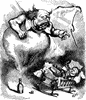 We work hard to make sure every data set in one of our visualizations tells a compelling story. One of our hardworking and fabulous research assistants recently collected a data set relating to presidential vetoes. The research quickly became much more complicated (and interesting) than we predicted...
 -
Sep 13, 2012
Early reviews are in: “A Visual History of the American Presidency”
Read more →By Eliza Keller (Originally published on April 30, 2010) We recently put out a beta version of our upcoming print, A Visual History of the American Presidency, on Mturk for proofreading and suggestions for improvement. We’re still working out the final kinks and incorporating suggestions from beta users/viewers, but we’re looking forward to a release soon! (The release is here now! - edited in September, 2012) In the meantime, check out some turkers’ reviews: “I felt that the chart was very informative and useful.” “Overall: Great looking poster, the graphs and charts make it easier and more interesting to read. [The] simple color...
-
Sep 13, 2012
SCOTUSblog Interviews Nathaniel
Read more →BY Eliza Keller (Originally published on Jan 5, 2010) Erin Miller of SCOTUSblog interviewed Nathaniel before the holidays, and she posted an edited version of the interview on the SCOTUSblog website. In case you missed it, the interview is reprinted below. Leave your comments! “A Visual History of the Supreme Court of the United States”: A new artistic project about the Court Posted by Erin Miller | Friday, December 18th, 2009 4:49 pm If you (like us) keep going back to the Wikipedia list of Supreme Court justices since 1789, you might try a more aesthetic way to get your information: the...
-
Sep 13, 2012
SCOTUS Sources
Read more →BY NGP (Originally published on April 9, 2010) Since we published our approach to A Visual History of the Supreme Court of the United States, we got quite a few requests for the sources of the poster. We decided to publish them here, with links. Comments are welcome! Epstein, Lee, Thomas G. Walker, Nancy Staudt, Scott Hendrickson, and Jason Roberts. (2010). “The U.S. Supreme Court Justices Database.” Chicago, IL: Northwestern University School of Law, January 26. http://epstein.law.northwestern.edu/research/justicesdata.html. Andrew D. Martin and Kevin M. Quinn. 2002. “Dynamic Ideal Point Estimation via Markov Chain Monte Carlo for the U.S. Supreme Court, 1953-1999.”...
-
Sep 13, 2012
Charting the SCOTUS "river"
Read more →BY NGP (Originally published on August 19, 2009) The Supreme Court chart visualizes the timelines of justices on the Court as a river, flowing up when there are more appointees by Republican presidents and flowing down with more Democratic appointees. (We take significant liberties with justices before the establishment of those two parties, aligning Democratic-Republicans with Democrats and aligning Whigs and Federalists with Republicans.) We know that many current observers view the progression of the Court through a partisan lens, assuming that Republicans aim to make a more conservative Court while Democrats seek to appoint more liberal members. Ideology has...
-
Aug 22, 2012
Introducing: A Visual History of the U.S. Senate
Read more →By NGP (Originally published on June 3, 2010) About twenty years ago, I had an idea to make a poster with a history of every senator who’s ever served in the U.S. Congress. I thought it would be neat to be able to trace the occupants of each seat in each state over time. I worked for a political redistricting firm at the time, and began to research the project, but I got busy and set it aside. I picked up the idea again this past year for Timeplots, and now we are almost done with an expanded and more...
 What do William Henry Harrison, Franklin Pierce, James Buchanan, Andrew Johnson, and Warren Harding have in common? They each earned a one-star rating on our
  For
For  In an effort to chart the U.S. economy in relation to each presidency, we did extensive research to determine the best measure of business cycles over time. In the end, the two data points we chose to best represent the ebb and flow of the U.S. economy were the most basic: consumer price index (CPI) and gross domestic product (GDP).
 What's a good measure of U.S. debt as a percentage of GDP over time? We take that into our poster
  We work hard to make sure every data set in one of our visualizations tells a compelling story. One of our hardworking and fabulous research assistants recently collected a data set relating to presidential vetoes. The research quickly became much more complicated (and interesting) than we predicted...