Print Gallery Print Gallery Print Gallery Print Gallery Print Gallery Print Gallery

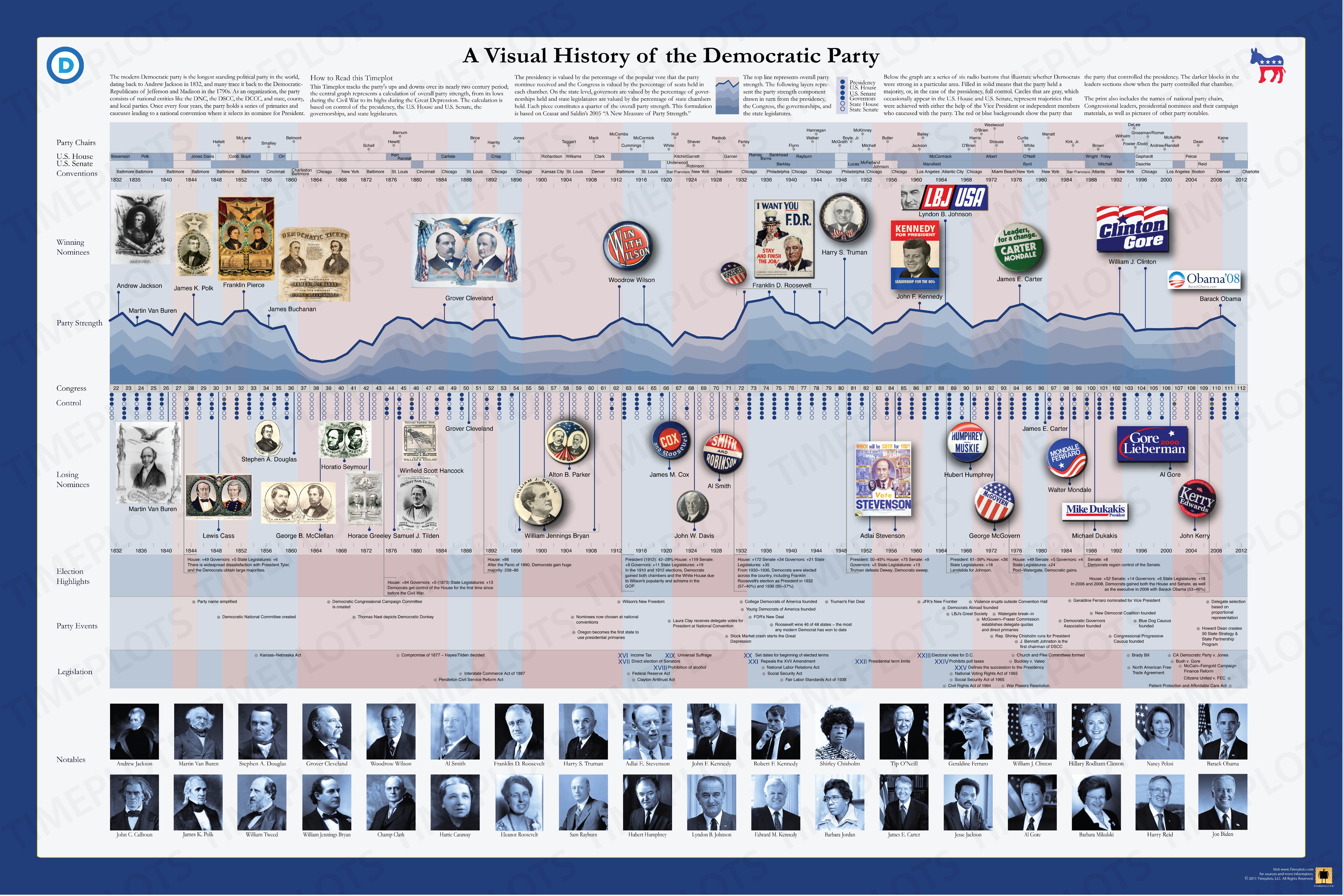
A Visual History of the Democratic Party

promotional discounts
We sometimes offer discounts to repeat customers.
size

36" x 24"

from
$199.95
framed
$29.95
print
options
options
Better Together!
Sale! get the 2 full-size Visual History prints of the Democratic and Republican Parties.

from
$389.95
framed
$49.95
print
options

This print is designed to be printed and displayed at 36″x24″.

This large-scale print is like nothing else available on the history of the Democratic Party. It places each party event in historical context, visualizing a remarkable range of party events, legislation, election results, and leadership to succinctly tell the story of the party. Narratives are displayed within the larger context of party strength by aggregating and annotating data on presidential elections, Congress, Governorships and State Legislatures. The Timeplot provides a new lens into American political history; it is not intended to be absorbed at a glance, but rather to be visited and revisited over time.

Because we take pride in our work, we are pleased to offer our customers a premium product: the Timeplot is printed on highest-quality 100-lb archival paper and measures a full 36 x 24 inches, the largest standard wall poster.

The printing process is certified “green” by the Forest Stewardship Council and uses elemental chlorine-free paper.

from the dem blog:

Calvin Coolidge

What we say:

Calvin Coolidge, a laconic conservative and former governor of Massachusetts, called for limited government, an isolationist foreign policy, tax cuts, and reduced spending. He signed restrictive immigration laws, decreased income tax rates, and vetoed farm relief bills. Coolidge was popular and served during a time of economic prosperity.

Coolidge Economy

Though immensely popular at the time of his presidency, Coolidge’s reputation suffers when linked to the Great Depression. His refusal to act during a Midwestern bank failure, coupled with his inaction to aid the agricultural sector and the growing disparity between rich and poor are seen as paving the ground for the eventual collapse of the stock market and spread of the depression throughout the entire country.

The ‘Roaring Twenties’ and Coolidge are inexorably linked. Coolidge’s support of business allowed the American economy to boom, which impacted and was impacted by the cultural, social, and artistic explosion of the same decade. Coolidge, however, was out of office for less than eight months before the Wall Street collapse occurred, and though Herbert Hoover is often blamed for the Depression, under Coolidge the stage for the collapse was set.

POTUSGarfield

What we say: James Garfield, a former senator from Ohio, sought to unite party factions with a balanced cabinet.  He was assassinated two months into his term.

James Abrams Garfield

James Abram Garfield’s largest accomplishment was his decision to choose Chester Arthur as his vice president, who would go on to sponsor civil-service reform.  Given his short term, Garfield did get a nominee appointed to the Supreme Court.  The in-fighting within the Republican Party during Garfield’s election was revealed in Garfield’s cabinet’s nominees and in his assassination – his assassin reportedly screamed his support for the Republican faction opposed to Garfield.

While working on the next set of prints, we wanted to take time out of our day to offer a fantastic deal for the holidays, (known in consumer talk as “Black Friday”).  Buy any print Friday, November 26th through Monday, November 29th and get 20% off.

We’re starting to ramp up a bunch of specials for the holidays, but this is one of the best. Check out the promotions page often – we will post new deals there, and let you know how long everything will be running.

Also, if you’re a student looking to purchase for your dorm room or as a gift for your parents – or if you spent time slaving away on a campaign, check out the promotions page because we now offer student and campaign worker discounts of 10% to any print.

Friday-Monday.  20% off.  Just use the code BF111, and get your SmartArt for the holidays.

FillmoreMillard Fillmore: 13th President, 1850-1853

What we say: “Millard Fillmore, a New York Whig, took office after Taylor’s death.  Fillmore supported the Compromise of 1850, but its Fugitive Slave Act cost him northern Whig support and the nomination.”

FillmoreMillard Fillmore was nominated to be Zachary Taylor’s Vice President on the basis of his anti-slavery views.  Upon Taylor’s death, and Fillmore’s ascension to President, slavery issues consumed much of Fillmore’s time.

Compromise of 1850 He supported the Compromise of 1850, working to pass it and believing it to be in the interest of the Union it was passed.  Both pro- and anti-slavery factions disliked portions of the bill, such as the refusal guarantee slavery in the southwest and the enforcement of the Fugitive Slave Act, and instead of receiving credit, Fillmore faced grumbling anger.

Fillmore’s other accomplishments were to send Commodore Matthew Perry to Japan, though Perry did not ‘open’ Japan until Pierce took office, and to initiate the White House library.  His two-star ranking comes because of his work to keep the status quo in effect with slavery.  The compromise of 1850 averted the question of slavery, but it came no closer to solving the question.  Fillmore is a good symbol of an era of Presidents who were incapable of solving the issue.

The final president in this low tier is Herbert Hoover.

Calvin Coolidge’s decision not to run for a second full term left Hoover the clear frontrunner for the Republican nomination in his party. In the election of 1928, Hoover was the first Republican to pioneer a “southern strategy,” and attacked Democratic candidate Al Smith on his Catholicism and his position in favor of the repeal of Prohibition.

Hoover is most often remembered as the president who presided over the start of  the Great Depression, but he did not cause the Great Depression, nor did he fail to act in response to Black Tuesday. He ranks among the worst presidents today because his actions in fact led a worsening of the Depression.

Hoover did fear too much government involvement, but by all accounts, two major pieces of legislation passed in response to the stock market crash – the Smoot-Hawley Tariff and the Davis-Bacon Act – were largely policy failures. Attacking Roosevelt’s “New Deal,” which had immense popularity across the nation, Hoover was soundly defeated by Roosevelt in 1932.

what others say:

“I like these a lot! What staffer on the Hill would dare NOT have one of these in their office?”
- Zach Gemignani, CEO Juice Analytics

“A very handsome piece!”
- Nigel Holmes, Author, Wordless Diagrams