Print Gallery Print Gallery Print Gallery Print Gallery Print Gallery Print Gallery

A Visual History of the American Presidency

promotional discounts
We sometimes offer discounts to repeat customers.
size

32" x 48"

from
$320.00
framed
$45.00
print
options
options
size

24" x 36"

.
$30.00
print
options
Better Together!

Sale! get the three full-size Visual History prints of the Presidency, Senate and Supreme Court for:

$99.00
print
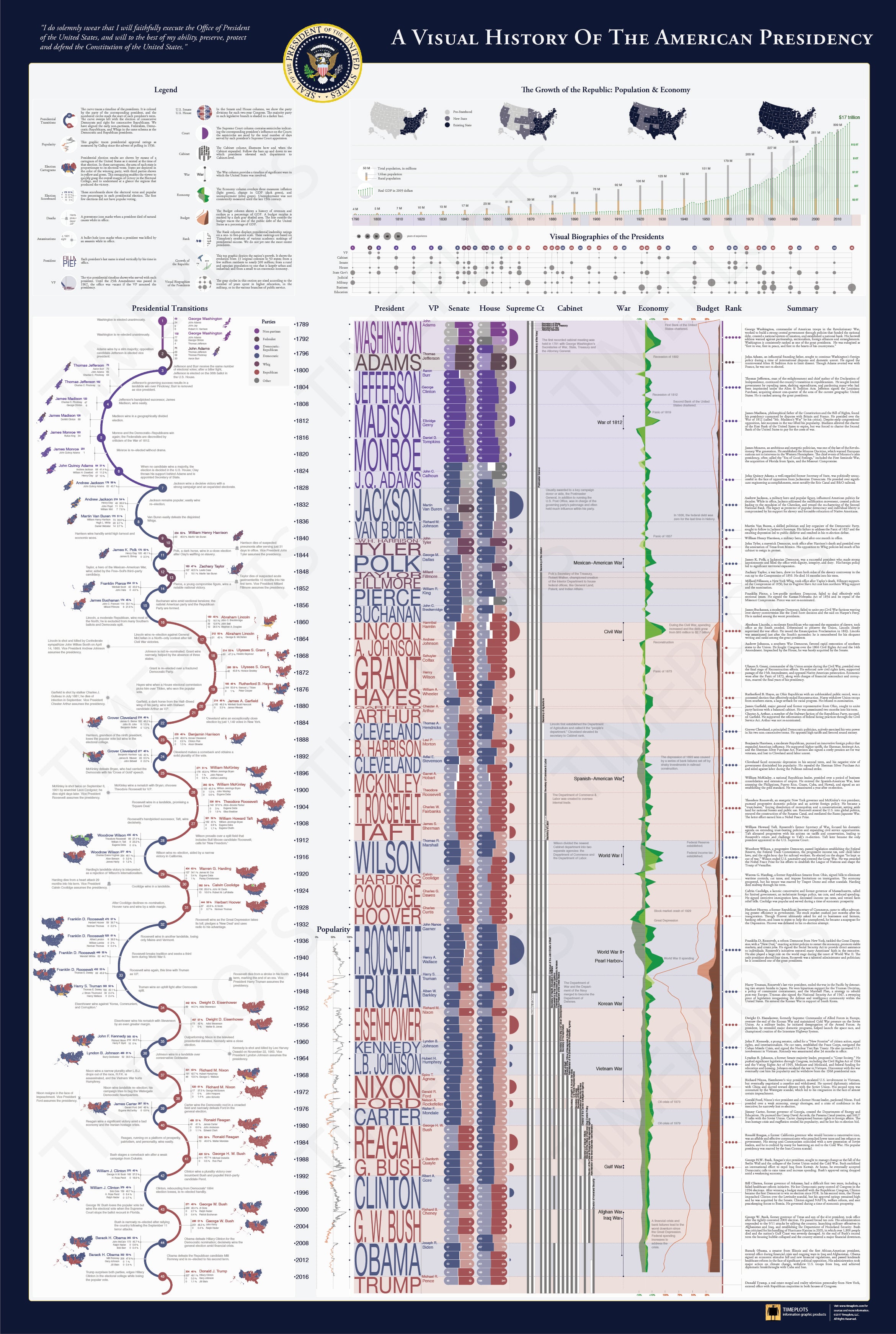
This large-scale (32″x48″) print displays the progress and development of the U.S. executive over time. It visualizes a range of interconnected political, social, and economic measures to tell the story of each president’s legacy, creating individualized narratives within the larger context of American political history. The print aggregates and annotates hard data on population, presidential elections, Congress, the Supreme Court, the Cabinet, the U.S. economy, and the federal budget to bring you a wide-lens view of American history.
Because we take pride in our work, we are pleased to offer our customers a premium product: the Timeplot is printed on highest-quality 100-lb archival paper and measures a full 48 x 32 inches, much larger than a standard wall poster.
The printing process is certified “green” by the Forest Stewardship Council and uses elemental chlorine-free paper.

This print is designed to be printed and displayed at 32″x48″. It is also available at 24″x36″, but please note that at the smaller size the text, though legible, is significantly smaller.

This large-scale print is like nothing else available on the history of the American presidency. It places each president in historical context, visualizing a remarkable range of political, social, and economic measures to succinctly tell the story of the presidency. Narratives are displayed within the larger context of American political history by aggregating and annotating hard data on population, presidential elections, Congress, the Supreme Court, the Cabinet, the U.S. economy, and the federal budget and debt. The Timeplot provides a new lens into American political history; it is not intended to be absorbed at a glance, but rather to be visited and revisited over time.

Because we take pride in our work, we are pleased to offer our customers a premium product: the Timeplot is printed on highest-quality 100-lb archival paper and measures a full 48 x 32 inches, much larger than a standard wall poster.

The printing process is certified “green” by the Forest Stewardship Council and uses elemental chlorine-free paper.

from the potus blog:

The final president in this low tier is Herbert Hoover.

Calvin Coolidge’s decision not to run for a second full term left Hoover the clear frontrunner for the Republican nomination in his party. In the election of 1928, Hoover was the first Republican to pioneer a “southern strategy,” and attacked Democratic candidate Al Smith on his Catholicism and his position in favor of the repeal of Prohibition.

Hoover is most often remembered as the president who presided over the start of  the Great Depression, but he did not cause the Great Depression, nor did he fail to act in response to Black Tuesday. He ranks among the worst presidents today because his actions in fact led a worsening of the Depression.

Hoover did fear too much government involvement, but by all accounts, two major pieces of legislation passed in response to the stock market crash – the Smoot-Hawley Tariff and the Davis-Bacon Act – were largely policy failures. Attacking Roosevelt’s “New Deal,” which had immense popularity across the nation, Hoover was soundly defeated by Roosevelt in 1932.

The legacy of Andrew Johnson has run the gamut from excellent to abominable. In the early twentieth century, the Republican Party of the 1860s was seen as beholden to business. In that light, Johnson, a Tennessee Democrat, was viewed as a “man of the people” and held in high esteem. A century later — by the 1960s — he was reviled as a president with southern sympathies who held back the civil rights movement.

The truth lies somewhere in between. Johnson was the only Southerner in Congress to remain loyal to the Union, and seems to have held the continuation of the Union as his highest priority in his work toward rapid North-South reconciliation after the war. To this end, he staked out a centrist path and kept his distance from the Radical Republicans. This move, however measured, inevitably placed him ideologically closer to the former Southern opposition than Northerners would have preferred.

President Johnson’s most marked failure was his lack of action in addressing the social and economic status of recently-freed slaves: it took significant effort from the Republican Congress, without much help from Johnson’s administration, to pass the Freedman’s Bureau and other laws.

Johnson's disdain for full suffrage

This 1867 Harper's Weekly illustration, "The Georgetown Election," mocks President Johnson's (left) stance in opposition to suffrage for freed slaves.

Johnson did oversee the purchase of Alaska and the U.S. Virgin Islands, and forced the French out of Mexico (where France was attempting to establish a satellite state and exploit the nation’s resources). France’s withdrawal ended the reign of Maximillian I of Mexico, the Austrian archduke installed by France.

Even considering these foreign policy accomplishments, Johnson’s failure of domestic post-war leadership and his disregard for civil rights places him squarely in our bottom tier of presidents.

For what it’s worth, the Congress at the time agreed — there were two formal efforts to impeach President Johnson: the first, in 1867, failed to pass the House; the second, in 1868, passed the House but failed (by a single vote) to receive the required two-thirds majority in the Senate.

Considered a “doughface,” or a Northerner with Southern sympathies, James Buchanan is widely considered the worst U.S. president. The Dred Scott Supreme Court decision was delivered by the Court in the first days of Buchanan’s presidency, and Buchanan was widely believed to have influenced the decision.

Buchanan’s administration spiraled downhill from his first day in office. Capitalizing on Buchanan’s lack of leadership on slavery and expansion, an energized Republican party seized control of Congress in the mid-term elections and blocked much of Buchanan’s weak proposals. During the Panic of 1857, he initiated the sale of Treasury revenue bonds and managed to enrage both Democrats and Republicans.

Most significantly, President Buchanan ignored the growing secessionist movement. Even after Abraham Lincoln’s controversial election, as Southern states announced their intention to secede from the Union, Buchanan nervously demurred taking action in the hopes that the crisis would resolve itself.

In its profile of James Buchanan, U.S. News & World Reports writes,

“To his dying day, he felt that history would treat him favorably for having performed his constitutional duty. He was wrong.”

Buchanan’s presidency serves as an example of the dangers of ignoring growing public discontent and frustration with the federal government. The Civil War, which broke out just a few months after Buchanan left office, would end up destroying a generation of young American men (and women), and dividing the nation for decades — if not centuries — to come.

William Henry Harrison, Franklin Pierce, James Buchanan, Andrew Johnson, and Warren Harding each received one-star ratings on A Visual History of the American Presidency. Harrison, really, deserves an incomplete — he only served thirty-two days in office.

The other three men who fall into our one-star category are slightly more interesting. President Franklin Pierce, for example, filled his cabinet with political rivals,  and to this day remains the only administration not to see any change in the cabinet during his tenure. He suffered from a seeming lack of willpower, however, when it came to the expansion of slavery.

Boston

Pierce stated in his inauguration that his administration “will not be deterred by any timid forebodings of evil from expansion.” Pierce continually temporized, refusing to cool the passions aroused by the Compromise of 1850 or the Kansas-Nebraska Act.

Posts on Buchanan — the president everyone loves to hate — and Harding will follow shortly.

What do William Henry Harrison, Franklin Pierce, James Buchanan, Andrew Johnson, and Warren Harding have in common? They each earned a one-star rating on our Visual History of the American Presidency. It’s not just us — a number of scholars consistently rank these men in the bottom tier of the nation’s presidents.

Judging poor presidents is difficult. Arguably, no president has acted with purpose and malice to weaken the nation. If — as my last post discusses — a good president is known for rising above his era and leading with optimism and confidence, then a bad president is one who shrinks from the responsibility of leadership. Overarching issues of the time are ignored in deference to political expediency; important decisions are bungled. We also considered those whose tenures were cut short by death, like William Henry Harrison, to have been similarly inconsequential.

What most often separates the one-star from the two-star presidents is context. We viewed progress as a net positive, and inertia (or regression) as a net negative: those who favored continuation of the status quo find themselves at the bottom of our rankings. The presidents in this lowest tier ignored or mishandled an overwhelming issue at the point in time during which it needed the most action and resolution.

As for the rest of the presidents – those who find themselves in the middle tier, with either three or four stars – they are the presidents who were somewhat perfect for their era. They did not necessarily stand out; did not necessarily bring transformational change, but also did not ignore or avoid pressing matters.  In some cases, they simply continued policies of their predecessors, and in others were not faced with era-defining issues. They may not have provided outstanding leadership, but they led the nation on a steady course.

Over the next couple of weeks, I’ll be posting the presidents by ranking, along with short explanations as to why they find themselves there.  None of our determinations will likely be earth-shattering, but there are some who may be controversial. I invite comments & questions as the blogging continues!

Click to view full size.

Click to view full size.

This c1860 political cartoon depicts James Buchanan as “Dismal Jemmy,” unsuccessfully navigating the tightrope between pro- and anti-slavery factions.

what others say:

“Extraordinary work.”
- Richard Saul Wurman, creator of the TED conferences and coiner of the term “information architect”

“There are infographics — and there are *infographics.* Count this in the latter category…. It’s filled with an entire book’s worth of information…. Brilliant, brilliant stuff.”
- Cliff Kuang, FastCompany.com

“Amazing, I love it!”
- Nigel Holmes, information designer & author of  graphic/information design books; former Graphics Director, Time Magazine

“Dude, it’s hot!!”
- Nicco Mele, Co-Founder and Partner at EchoDitto, Internet Operations Director of Gov. Dean’s presidential primary campaign in 2003

“It’s beautiful!”
- Todd Cavalier, Executive Director, Senior Creative Director, Informatics Studio

“Very cool, man!”
- Josh Ross, managing partner, Trilogy Interactive, Internet Director at Senator Kerry’s campaign for President in 2004

“Love it. The White House should get and display one.”
- Blake Zeff, BerlinRosen Public Affairs; New York Communications Director, Obama for America; Spokesman, Hillary Clinton for President

“Distilling all of the political, economic, and historical information that this poster has to offer is an amazing achievement. Presenting that information in such a useful, intuitive, and beautiful way is even more impressive. It’s a must-have for anyone interested in presidential politics.”
- Jeffrey B. Lewis, Associate Professor Department of Political Science, University of California Los Angeles

“Cool stuff! The perfect gift for political junkies.”
- Mark Sullivan, Founder, Voter Activation Network

“It’s great! See the counterpoint among national evolution along key fiscal, demographic, and size-of-economy dimensions, presidential history, the development of the cabinet, and configurations of party control of national government.”
- Rick Valelly, Professor of Political Science, Swarthmore College

“People who love american politics will love this. Tremendous work.”
- Sarah Slobin, infographics editor, The Wall Street Journal (formerly of The New York Times & Fortune Magazine)

________________________________________

and overheard in 140 or less

360surveys: INCREDIBLE info graphic of our nation’s #presidential #leaders– add this to my birthday wishlist! http://timeplots.com/potus/

pamdodd: Fascinating! > A Visual History of the American Presidency | timeplots.com http://ht.ly/2gwxm

nickfabiani: @pazzler DUDE. http://bit.ly/b9gPTf

silverhallide: Great visual. Always a fan of infographics RT @GOOD: A history of the American presidency in one infographic http://su.pr/21scYx

brainpicker: A visual history of the American presidency – wonderfully detailed info-timeline by @Timeplots http://bit.ly/crC7jM

Columbeurs: Visual History of the American Presidency: More beautifully detailed work from Timeplots. http://bit.ly/9BUgV3

wantmag: Beautiful and meaningful graphic timelines (on US politic trends) by @timeplots. We can’t wait for the iPad version! http://want.by/da7GGQ

danielleking: the most impressive inforgraphic i’ve seen: http://timeplots.com/potus/#

simeons: It says it all: cool infographic about presidents’ approval ratings over time. http://bit.ly/blkPVS #potus

etherealtim: An epic work of US presidential infography http://timeplots.com/potus by Timeplots – thanks @GOOD

Pauble: Very cool info on the history of Presidents. Someone buy a print for me! http://timeplots.com/potus/#

rjurney: Really nice timelines at http://timeplots.com/

GunarPenikis: A Visual History of the American Presidency | timeplots.com http://bit.ly/aQpHvn awesome

shawnfbowman: Interesting: a well-done visual presentation of data – “Visual History of US Presidency”: http://bit.ly/aEI40m

zakiwarfel: beautiful info graphics at http://timeplots.com/

IntegritySTL: History buffs get ready. We like infographics at Integrity: This is an awesome one about US presidents http://timeplots.com/potus/

karaml: Visual History of the American Presidency – los sUper #infographic – the economy/budget chart is most interesting http://bit.ly/blkPVS

negrititico: me toy haciendo como fan de los infográficos jeje, A Visual History of the American Presidency http://timeplots.com/potus/ #fb

cepheid: * An entire american history class jammed into one infographic. I give you “A Visual History of the American Presidency” http://ow.ly/1WPT1

oster_ph: http://bit.ly/c5Hgwt I like this. this is where print just can’t be replaced by the web.

TechOntologist: Awesome #infographic of Visual History of the American Presidency http://timeplots.com/potus/ Great data to ink ratio. #tufte influenced

paulajohnson: Thinking “A Visual History of the American Presidency” is the coolest chart ever. http://timeplots.com/potus/

pascal_assaleh: Really Cool charts http://timeplots.com/projects/

kwheeler: Very cool infographic on American presidents. Amazing interactive chart as well as a print that you can buy. http://timeplots.com/potus/

ptretheway: awesome, information rich infographic :: A Visual History of the American Presidency | timeplots.com http://ow.ly/1WLtr

allofek12: Infographic of American Presidency–cool display! http://bit.ly/avMaDY

KevinBrandall: COOOL! The Visual History of the American Presidency (by student of Edward Tufte who is busy with today) http://bit.ly/caWHnT @FastCompany

gregbamford: US History teachers: a visual history of the American presidency! RT @fastcompany http://bit.ly/caWHnT

mooresclassroom: Incredibly detailed poster: Visual History of the American Presidency http://bit.ly/bmJRI4 #historyteacher #history

evarab: Another great infographic: A Visual History of the American Presidency http://bit.ly/bCmWfm #infographics

NedPoulter: A visual history of the American Presidency [Infographic] http://bit.ly/c1E2gQ pretty incredible level of detail…!

setlinger: Stunning #infographic on the Visual History of the American Presidency http://is.gd/cB4VC Great data-to-ink ratio /via @mibi

mibi: A most comprehensive infographic on the Visual History of the American Presidency http://is.gd/cB4VC Great data-t-ink ratio

SuperMNet: Timeplots releases a new infographic poster: A Visual History of the Presidency. High quality stuff http://timeplot… http://w.sns.ly/mz244

davecounts: Very cool data visualization by a friend from school http://timeplots.com/projects/

zachgemignani: Timeplots releases a new infographic poster: A Visual History of the Presidency. High quality stuff http://timeplots.com/potus/

_Kaitie_: This is pretty cool for political junkies! “A Visual History of the American Presidency” http://bit.ly/cScqvQ #presidency #politics #USA

dmjanis: Visual History of the American Presidency: http://bit.ly/9cYPwJ. Let us know what you think! /via @timeplots /via @cjanis <– That’s sweet!

fcinq: “A Visual History of the American Presidency”: en fait, c’est celle la que je veux, chez @timeplots http://bit.ly/b9gPTf #dataviz

“Love it. The White House should get and display one.”
- Blake Zeff, BerlinRosen Public Affairs, New York communications director for Obama campaign, spokesman for Hillary Clinton’s presidential campaign.