Print Gallery Print Gallery Print Gallery Print Gallery Print Gallery Print Gallery

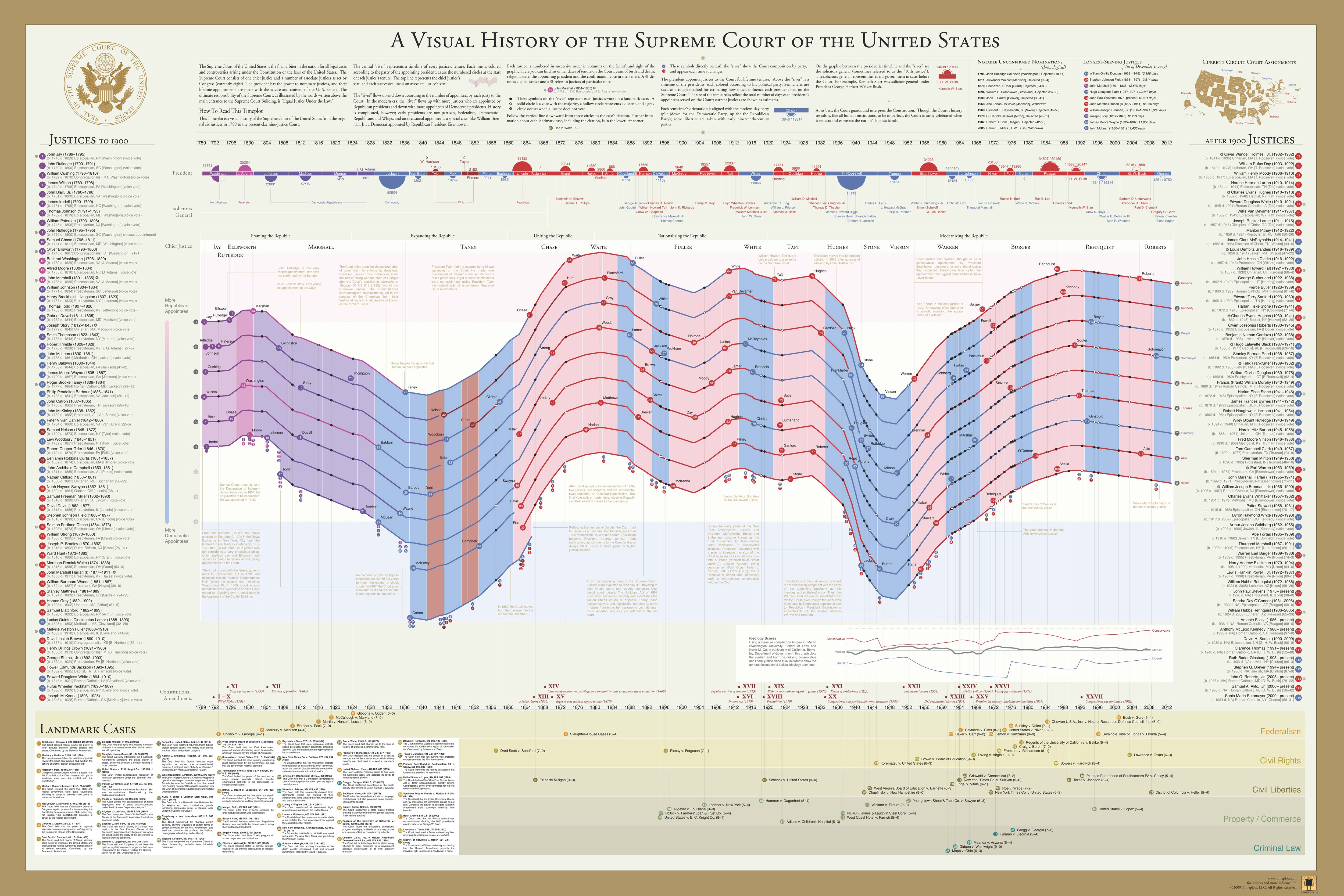
A Visual History of the Supreme Court of the United States

promotional discounts
We sometimes offer discounts to repeat customers.
size

48" x 32"

from
$319.95
framed
$44.95
print
options
options
Better Together!
Sale! get the 3 full-size Visual History prints of the Supreme Court, Presidency, and Senate.

from
$924.95
framed
$99.95
print
options

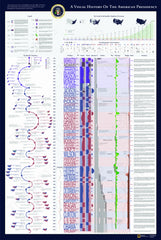
This large-scale (48″x32″) print displays the full sweep of American federal judicial history from 1789 to 2010. It combines biographical information on every Supreme Court justice with a visualization of the influence of U.S. presidents and their political parties on the Court over time, and includes vote counts and summaries of landmark cases. We hope that those interested in the Court and judicial history—including lawyers, policymakers, and history buffs—will find this a useful and engaging product.

A Visual History of the Supreme Court represents the culmination of many months of careful research, design, and consultation with experts. Because we take pride in our work, we are pleased to offer our customers a premium product: the Timeplot is printed on highest-quality 100-lb archival paper and measures a full 48 x 32 inches, much larger than a standard wall poster.

The printing process is certified “green” by the Forest Stewardship Council and uses elemental chlorine-free paper.

from the scotus blog:

While working on the next set of prints, we wanted to take time out of our day to offer a fantastic deal for the holidays, (known in consumer talk as “Black Friday”).  Buy any print Friday, November 26th through Monday, November 29th and get 20% off.

We’re starting to ramp up a bunch of specials for the holidays, but this is one of the best. Check out the promotions page often – we will post new deals there, and let you know how long everything will be running.

Also, if you’re a student looking to purchase for your dorm room or as a gift for your parents – or if you spent time slaving away on a campaign, check out the promotions page because we now offer student and campaign worker discounts of 10% to any print.

Friday-Monday.  20% off.  Just use the code BF111, and get your SmartArt for the holidays.

Our chief sources for A Visual History of the Supreme Court of the United States are listed below:

Epstein, Lee, Thomas G. Walker, Nancy Staudt, Scott Hendrickson, and Jason Roberts. (2010). “The U.S. Supreme Court Justices Database.” Chicago, IL: Northwestern University School of Law, January 26.
http://epstein.law.northwestern.edu/research/justicesdata.html.

Andrew D. Martin and Kevin M. Quinn. 2002. “Dynamic Ideal Point Estimation via Markov Chain Monte Carlo for the U.S. Supreme Court, 1953-1999.” Political Analysis. 10:134-153. http://mqscores.wustl.edu/measures.php.

The Oyez Project. http://www.oyez.org/.

U.S. Department of Justice. “Solicitors General of the United States.”
http://www.justice.gov/osg/aboutosg/sglist.html.

Hogue, Henry B. CRS Report for Congress, “Supreme Court Nominations Not Confirmed, 1789-2004,” 21 March 2005.
http://fpc.state.gov/documents/organization/50146.pdf [PDF].

The information we used regarding the presidents (dates of terms, etc.) are widely available. We used workers in Amazon’s Mechanical Turk service to fact-check our names and dates. We initially approached Mechanical Turk as an experiment in outsourcing fact-checking; the work we received from its workers ran the gamut from useful to wacky. The useful work, though, proved the experiment to be worth it — we received thoughtful comments on everything from design and layout to the presentation of the data itself.

Wikipedia. http://en.wikipedia.org/. A note on Wikipedia: We find Wikipedia to be a highly useful source for finding information quickly. However, since it is an open platform (http://en.wikipedia.org/wiki/Citing_Wikipedia), we made sure to corroborate any first findings on Wikipedia with other sources.

Erin Miller of SCOTUSblog interviewed Nathaniel before the holidays, and she posted an edited version of the interview on the SCOTUSblog website. In case you missed it, the interview is reprinted below. Leave your comments!

“A Visual History of the Supreme Court of the United States”: A new artistic project about the Court

Posted by Erin Miller | Friday, December 18th, 2009 4:49 pm

If you (like us) keep going back to the Wikipedia list of Supreme Court justices since 1789, you might try a more aesthetic way to get your information: the new Timeplots poster, A Visual History of the Supreme Court of the United States. The “niche info art” poster, which went on the market last week, displays in granular detail the entire history of the Court’s justices, cases, and context. You can see a zoomable image of the poster (and purchase it) at the Timeplots website here.

The poster plots the timeline of the Court’s justices on one axis against a measure of their relative appointment by Republican or Democratic presidents on the other. But into that basic structure it sneaks a wealth of other information about the Court’s important decisions, events, and personnel.

The Supreme Court poster is just the first of many planned “Timeplots” of institutions by the start-up Timeplots, Inc. I interviewed the company’s founder, Nathaniel Pearlman, about his project earlier this week. The content of this post largely comes from him.

The original vision:

It all started with a class Pearlman took at Yale a couple of decades ago on visualizing information and a job in election data services that he had in the early 90s with a company that produced election maps, but Pearlman only had a chance to begin work on his ideas this year. (Timeplots runs out of the corner of the political technology company he founded in 1997, NGP Software, Inc.) Pearlman, who at one time was a doctoral candidate at MIT studying American politics, has long been interested in the Supreme Court, an institution that he describes as “central to the Republic.”

The poster’s intent is to capture the “entire sweep” of the Court’s history, both the minute details (what was the confirmation vote of Justice John Clarke?) and the big picture (which ten justices were most notable?). The way he describes it, “you can either zoom into the history in detail or walk back from it and see it all.” A secondary aim is to honor the individuals involved in the Court over time.

Research behind the poster:

The “Visual History” was in the works for many months. Most of that time was dedicated to planning the visualization and generating it — but a good deal was spent researching the impressive array of facts.

The poster includes timelines of justice appointments, chief justices, Solicitors General, the presidents and parties who nominated each justice (including a visualization of the relative influence of each president on the Court), the ideological slant of the Court (reflected in an a separate graph of the most liberal and most conservative justices each Term); momentous events (like the ending of the justices’ duty to “ride circuit” in 1891); constitutional amendments; as well as lists of landmark cases, the justices and their basic biographical facts, notable justices, notable unconfirmed nominees, and longest-serving justices. The data about ideological scores for decisions comes from political science and law professor Andrew Martin, whom the blog recently interviewed about the Supreme Court Database he coordinates.

Judgment calls:

Much of the factual information on the plot is publicly available. But Timeplots included some features on the poster that require judgment, like a list of the ten most “notable” justices and the selection of fifty-plus “landmark” cases. Pearlman consulted with constitutional scholars and lawyers on these lists, but welcomes more feedback; he will consider changing them with future updates of the poster.

Another set of decisions for the poster-makers was which momentous events to include on the graphic. For example, the timeline notes the appointment of the first Jewish justice and the only resignation by a justice.

The parties of the presidents who appointed the justices and the partisan make-up of the Court are centrally displayed on the timeplot (as the y-axis, in fact). But Pearlman isn’t necessarily suggesting by that choice that politics sway the Court’s decisions. Rather, he says the poster’s objective depiction of the facts lets observers come to their own conclusions about the nexus between the Court and the president. In fact, he notes (even on the poster) that the Timeplot data demonstrates that the link between the ideological slant of decisions and the party whose presidents appointed a majority of the justices is weak over time.

Future plots:

The next two planned posters, Pearlman says, are on the Presidency and Congress. Pearlman says he has a list of at least fifty more subjects that he would like to tackle if things go well, but for now they remain under wraps.

What would a “visual history” of SCOTUSblog look like?

When I asked him this question, Pearlman showed his mastery of the art of visualizing information by rattling off rapid-fire a list of details he would need about the blog: the number of visitors, when our contributors started working and their tenure, the subjects we have covered during the last five years, and even the frequency of the words that we use.

Just for fun – intrigued by Pearlman’s words – I generated a word cloud of SCOTUSblog on the web application Wordle.

More information about “A Visual History” is available on the company’s blog, here. Pearlman can be reached at ngp@timeplots.com.

While compiling the data that went into our Supreme Court Timeplot, a few justices stood out from the crowd. The name “Lucius Quintus Cincinnatus Lamar II,” the 50th justice of the Supreme Court, sparked my curiosity—so I looked into it.

L.Q.C. Lamar was named after his father, who was named after the ancient Roman consul and dictator Lucius Quinctius Cincinnatus. Interestingly, LQC II’s father’s brother was the second president of the Republic of Texas; named Mirabeau Buonaparte Lamar, they were apparently both named after historical heroes of their eccentric uncle.

L.Q.C. Lamar had quite the career before he was nominated to the U.S. Supreme Court by President Grover Cleveland in 1888.

Lucius-Quintus Lamar was elected to numerous political offices, serving in the Mississippi and Georgia state houses and the U.S. House in 1856 (from which he resigned following the founding of the confederacy). He was the drafter of the Mississippi Ordinance of Secession, and was Confederate Foreign Minister to Russia. After the Civil War, Lamar directed the University of Mississippi School of Law, where he introduced the “case method” of law school study. Lamar returned to U.S. House from 1873-77, served in the U.S. Senate from 1877-1885, and as Secretary of the Interior from 1885-88.

L.Q.C. Lamar was profiled in John F. Kennedy’s Pulitzer Prize-winning Profiles in Courage. He was noted for the courage of his eulogy of Northerner Charles Sumner, the vocal abolitionist senator from Massachusetts. Sumner had been vilified in the South during the Civil War. When L.Q.C. delivered Sumner’s eulogy, his words and his passion apparently caused congressmen on both sides of the aisle to weep openly. Press reports across the nation were effusive in their praise.

Here is the closing portion of his speech:

Bound to each other by a common constitution, destined to live together under a common government, forming unitedly but a single member of the great family of nations, shall we not now at last endeavor to grow toward each other once more in heart, as we are already indissolubly linked to each other in fortunes?

Shall we not, over the honored remains of this great champion of human liberty, this feeling sympathizer with human sorrow, this earnest pleader for the exercise of human tenderness and charity, lay aside the concealments which serve only to perpetuate misunderstandings and distrust, and frankly confess that on both sides we most earnestly desire to be one ; one not merely in community of language and literature and traditions and country; but more, and better than all that, one also in feeling and in heart? . . .

I know well the sentiments of these, my Southern brothers, whose hearts are so infolded that the feeling of each is the feeling of all; and I see on both sides only the seeming of a constraint, which each apparently hesitates to dismiss. The South prostrate, exhausted, drained of her lifeblood, as well as of her material resources, yet still honorable and true accepts the bitter award of the bloody arbitrament without reservation, resolutely determined to abide the result with chivalrous fidelity; yet, as if struck dumb by the magnitude of her reverses, she suffers on in silence.

The North, exultant in her triumph, and elated by success, still cherishes, as we are assured, a heart full of magnanimous emotions toward her disarmed and discomfited antagonist; and yet, as if mastered by some mysterious spell, silencing her better impulses, her words and acts are the words and acts of suspicion and distrust.

Would that the spirit of the illustrious dead whom we lament today could speak from the grave to both parties to this deplorable discord in tones which should reach each and every heart throughout this broad territory: “My countrymen! Know one another, and you will love one another.”

Our Timeplot of the history of the Supreme Court features 53 landmark cases from the beginning of the Court to present day. For each case, we indicate how each of the justices on the Court at the time voted. As one of our reviewers noted, choosing that list of cases is a fairly subjective process, but makes for a pretty good parlor game.

landmark_cases

So how did we decide which cases to include? We consulted a variety of lists of landmark cases published by various academic and historical institutions, and we consulted with a number of serious students of the Court—people like lawyers, professors of law, and political scientists specializing in American history.

Some more prominent cases, like Marbury v. Madison, Dred Scott, or Roe v. Wade, would likely make anyone’s list of the top fifty or so. Others are more debatable. How would you have revised the list? Leave us your comments.

what others say:

___________________________________________________

“My first impression when I unraveled the poster was WOW! The eyes can have a field day staring at this enormous, data-rich poster. Everything about it says high quality… A good infographic is like reading a book, only in a much more efficiently digestible manner. That is the feel I get with this poster. It displays multiple dimensions of information, complemented nicely with annotation… Infographics truly do not get much better than this.”
-Justin Wehr, Wehr in the World

___________________________________________________

“Beautiful product!”
-David Mayhew, Professor of Political Science, Yale University
___________________________________________________

A Visual History of the Supreme Court is a masterful data visualization.  We framed a copy and hung it on the wall at Fastcase: informative, fascinating and beautiful. Anyone who cares about the history of the Supreme Court should purchase a copy immediately.”
-Ed Walters, CEO, Fastcase.com

___________________________________________________

“If you (like us) keep going back to the Wikipedia list of Supreme Court justices since 1789, you might try a more aesthetic way to get your information: the new Timeplots poster, A Visual History of the Supreme Court of the United States. The ‘niche info art’ poster displays in granular detail the entire history of the Court’s justices, cases, and context… [and] into that basic structure it sneaks a wealth of other information about the Court’s important decisions, events, and personnel.”
-Erin Miller, SCOTUSblog
___________________________________________________

“Really spectacular!”
-Bert Johnson, Associate Professor of Political Science, Middlebury College
___________________________________________________

“This is a really great visualization. In just one poster, the authors convey a tremendous amount of relevant information to the end user. I would highly recommend acquiring this visualization for any SCOTUS fan on your holiday list!”
-Daniel Martin Katz, Computational Legal Studies Blog
___________________________________________________

“This chart works well on two levels: The broad flow of judges displays clear shifts in partisanship through time, and the many details draw in the reader while providing critical information about significant players, cases, and events. I’m a fan.”
-Steve Ansolabehere, Professor of Government, Harvard University
___________________________________________________

“[The] new poster from Timeplots does an impressive job displaying the history of the U.S. Supreme Court.”
-Randall Hand, VizWorld.com
___________________________________________________

“Intriguing and complex.”
-Edward Tufte, EdwardTufte.com

___________________________________________________

“Ingenious and alluring… Its method of presentation invites the intellectual curiosity associated with those who follow the Court. The method is novel… like a composer’s appeal to both form and substance, the ‘listener’ is taken deeper into the meaning by way of both.”
-Thomas Kosmo, President, The Mentor Group Boston
___________________________________________________

“Looks totally cool—what a great creation!”
-Kathryn Morse, Director, Program in Environmental Studies; Associate Professor, Department of History, Middlebury College
___________________________________________________

“Wow. This is very cool. Can I just say I want a copy?”
-Jeffrey L. Fisher; Associate Professor of Law and Co-Director, Supreme Court Litigation Clinic; Stanford University Law Professor
___________________________________________________

“The Visual History of the Supreme Court has a tremendous amount of valuable information packed into one print.  Outstanding level of detail!  The closer you get, the more you find.”
-Randy Krum, www.coolinfographics.com
___________________________________________________

“As the Czar of FantasySCOTUS.net, I can say that A Visual History of the Supreme Court of the United States provides a fantastic overview of the history of the Supreme Court, and how the ebb and flow of appointments have corresponded to some of the great landmark cases. I would definitely recommend this print to any SCOTUS aficionado.”
-Josh Blackman, FantasySCOTUS.net

___________________________________________________

“This is high art. I hope every school in America will display this.”
-David K. Bain; CEO, Viral Media Productions, LLC

___________________________________________________

___________________________________________________

And overheard in 140 or less…

ActuVisu: Great #Dataviz : A Visual History of the Supreme Court of the United States by @timeplots via @nicolasvoisin http://icio.us/nx52at

fcinq: Si vous ne savez pas quoi m’offrir pour me remercier de mes twitts, je me contente de cela : http://bit.ly/5RcG7H #scotus #dataviz #craquage

acitrano: A Visual History of the Supreme Court: http://bit.ly/cQIwx6 [awesome]

jcardfern: A Visual History of the Supreme Court of the United States. An info-graphic masterpiece. http://timeplots.com/scotus/

msmcomms: Just got map of Supreme Court in the mail – amazing (http://timeplots.com/scotus/) thanks @timeplots

Dailywrit: Still lusting for the SCOTUS timeplots poster. http://bit.ly/5RcG7H

jeblucas: @infobeautiful Really nice looking Supreme Court time plot. http://timeplots.com/scotus/

MikePCpitstop: Supreme court history at a glance … information at its best: http://timeplots.com/scotus/

ruthienm: I am now the proud owner of this poster: http://timeplots.com/scotus/

BennettKlein: These guys are hardcore info geeks (click and zoom) – A Visual History of the Supreme Court; http://bit.ly/7yphnB

dwhite: Unbelieveable Supreme Court timeplot/poster… http://timeplots.com/scotus/ a must for all teachers, so detailed and comprehensive!

aquatiki: It’s been a while since I lusted after a poster: #SCOTUS http://timeplots.com/scotus/

jeffpar: Visual History of SCOTUS has been installed in the den: http://tinyurl.com/ydbx6of – get yours at http://timeplots.com

politicsmag: Political data visualized; great political print from Timeplots http://bit.ly/5RcG7H: First in series! Stay tuned for more from TP and us.

malialazu: a visual history of the supreme court great for all history geeks like me http://bit.ly/5RcG7H anyone wanted to get me a late xmas gift?

MatthewEyre: A superb visual history of the United States Supreme Court http://timeplots.com/scotus/

wegreenlaw: Like visual representations of data and ideas? Like the Supreme Court? You will LOVE http://timeplots.com/

EJWalters: RT @lawlib: A Visual History of the Supreme Court of the United States http://bit.ly/4H6C5z // REALLY GREAT – JUST GOT MINE!

_PixelPixie_: This is neat: A visual history of the U.S. Supreme Court http://bit.ly/87wWlw Katz & Bommarito, Timeplots.com (via @richards1000)

rtkrum: Just received my copy of the fabulous poster, History of the SCOTUS (Supreme Court of the United States). Love it! http://bit.ly/8cp6lq

thorlakur: Oooog hér er linkurinn sem vantaði í síðasta tvitt: http://timeplots.com/scotus/ >Mögnuð grafík yfir alla hæstaréttardómara BNA frá upphafi (með meiru).

arenda: A Visual History of the Supreme Court of the United States- http://tinyurl.com/yesdbfx | Very Cool!

nicco: Supreme Court Data Visualization: Great holiday gift for political junkies or data junkies: http://bit.ly/8ZruwK

matthewjhoward: Know a lawyer in DC? Want a great idea for a Christmas gift? Check out www.timeplots.com. Super cool company founded by @realnathaniel

lawrencehurley: A holiday gift for the SCOTUS junkie in your life? http://timeplots.com/scotus/

rtsadam: #timeplots; A visual history of the SCotUS. The print shows the full sweep of the Court’s history from 1789 to 2009; timeplots.com/scotus

eni_kao: L’histoire de la Cour Suprême : une impressionnante infographie. http://bit.ly/5U3ESC

risenc: Perfect gift for a legal geek — visual history of the Supreme Court: http://timeplots.com/scotus/

VISup: A Visual History of the Supreme Court of the United States http://timeplots.com/ #infographic

RSuelzer: @timeplots OMG, I love your SCOTUS time plot. I want to get one for my Con Law prof… too bad i am a poor colege student! maybe next year

TomLoveland: Awesome poster/niche info art: “Visual History of the Supreme Court.” First piece from www.timeplots.com. Great gift. Bought 3!

randelsd: ( A Visual History of the Supreme Court of the United States) timeplots.com – http://bit.ly/5GIEMO This might be a nice holiday gift

Jahrabizad: A picture history of the Supreme Court http://timeplots.com/scotus/

JaimeNPeters: niche info art – I like it http://timeplots.com/

johannesma: for fans of charts + graphs – A Visual History of the Supreme Court of the United States http://timeplots.com/scotus/ @timeplots

kirstinbutler: Timeplots http://timeplots.com/ Beautiful data vis prints for your inner infomaniac

garrick_s: @ericasmith Wow, dig this: http://timeplots.com/scotus/

Larryferlazzo: Infographic on history of Supreme Court http://timeplots.com/scotus/

SCOTUSblog: Erin: Just found the best Christmas gift ever for your local Supreme Court practice head: http://timeplots.com/scotus/

AmyPritchard: check out a really interest project “A Visual History of the Supreme Court” at www.timeplots.com/scotus or follow @Timeplots here on twitter

krees: great subject matter…. lovely visualization… and huge to boot! congrats on the launch @timeplots! http://timeplots.com/scotus/

rodageo: I really like these guys, check them out! RT: @timeplots: Timeplots launch covered very generously at www.coolinfographics.com. Nice to see!

PeterDaou: Interesting new project by a friend: http://timeplots.com/ (tells complex stories in visual form)

cattleprod: @timeplots The SCOTUS poster is great! Perfect for educators, nerds and our entire dumb country. Count me in as a buyer.
___________________________________________________